On 9 October 2025, China’s Ministry of Commerce issued six coordinated announcements (Nos. 55, 56, 57, 58, 61 and 62) that together represent the most aggressive rare earth export control package Beijing has ever assembled. Five additional rare earth elements, holmium, erbium, thulium, europium and ytterbium, joined the already controlled dysprosium, terbium, samarium, gadolinium, lutetium, scandium and yttrium. For the first time China introduced a Foreign Direct Product Rule analogue with a 0.1 percent de minimis threshold. Five days later, on 14 October, USTR’s port fees of $50 per net ton on Chinese-operated, Chinese-built or Chinese-owned vessels went live. Thirteen days after that, USTR opened a formal Section 301 investigation into China’s Phase One agreement compliance. The chemical supply chain that functioned on 8 October is not the one you’re operating in today.
This cornerstone walks you through what the MOFCOM six-pack actually does, why the 0.1 percent de minimis rule is a structural shift and not a negotiating card, how the port fees compound on freight you’ve already paid, and the real arithmetic for an Australian importer moving catalyst chemistries, specialty magnets-adjacent compounds, and general industrial chemical tonnage out of Shanghai, Ningbo-Zhoushan and Qingdao. There’s no simple hedge for this one. There is a sequence of decisions you need to make before 15 November.
The MOFCOM six-pack: what each announcement controls
MOFCOM structured the 9 October package as six separate announcements, each layering a different control mechanism on top of the existing Export Control Law framework. Announcement No. 55 adds holmium, erbium, thulium, europium and ytterbium to the dual-use rare earth list, bringing the controlled set to twelve elements. Announcement No. 56 imposes specific controls on rare earth processing technology, including mining, extraction and separation know-how. Announcement No. 57 targets rare earth magnet manufacturing technology, a measure that has ripple effects into motor, wind turbine and EV drivetrain supply chains but also, crucially for chemical importers, into the catalyst and specialty alloy precursor chain.
Announcement No. 58 is the one most commentators are underweighting. It introduces what is effectively China’s first Foreign Direct Product Rule: any item produced outside China that contains more than 0.1 percent by value of the controlled Chinese rare earths, or that was manufactured using Chinese-origin rare earth processing technology, requires an export licence from MOFCOM to move onward to certain end users. The 0.1 percent de minimis threshold mirrors the US FDPR structure that has been applied to semiconductors, and it is a deliberate signal that Beijing intends to exert extraterritorial jurisdiction over products anywhere in the world that embed controlled Chinese inputs.

Announcements Nos. 61 and 62 extend controls to specific industrial applications and add new end-user restrictions including a defined defence exclusion list. Between them, the six announcements capture not just raw rare earth chemistry but a substantial portion of the intermediate industrial catalyst, polishing compound, phosphor and specialty pigment value chains that Chinese producers have dominated for the past fifteen years.
The twelve controlled rare earth elements (post 9 October 2025)
| Element | Symbol | Prior status | Post Oct 9 | Primary chemical application |
|---|---|---|---|---|
| Dysprosium | Dy | Controlled (Apr 2025) | Controlled | Permanent magnets, catalysts |
| Terbium | Tb | Controlled (Apr 2025) | Controlled | Phosphors, fuel cells |
| Samarium | Sm | Controlled (Apr 2025) | Controlled | SmCo magnets, catalysts |
| Gadolinium | Gd | Controlled (Apr 2025) | Controlled | MRI contrast, nuclear reactors |
| Lutetium | Lu | Controlled (Apr 2025) | Controlled | Catalysts, PET imaging |
| Scandium | Sc | Controlled (Apr 2025) | Controlled | Aerospace alloys, fuel cells |
| Yttrium | Y | Controlled (Apr 2025) | Controlled | Superconductors, phosphors |
| Holmium | Ho | Uncontrolled | Controlled | Nuclear control rods, lasers |
| Erbium | Er | Uncontrolled | Controlled | Fibre optic amplifiers, lasers |
| Thulium | Tm | Uncontrolled | Controlled | Portable X-ray sources |
| Europium | Eu | Uncontrolled | Controlled | Red phosphors, nuclear control |
| Ytterbium | Yb | Uncontrolled | Controlled | Laser crystals, stress gauges |
If your product bill of materials has any of these twelve elements in even minor concentrations, you need to audit whether your Chinese supplier’s export documentation cites a valid MOFCOM export licence. No licence, no legal export. Your forwarder carrying the shipment without that licence is exposed under Chinese law and your Australian customs broker has no shield on the landing side either.
The 0.1 percent de minimis rule: why this is a structural shift
The FDPR-style provision in Announcement No. 58 is the part that changes medium-term planning more than anything in the package. Under the US FDPR precedent that China has now mirrored, jurisdiction extends to products manufactured anywhere in the world if they embed controlled Chinese inputs above the de minimis threshold. A magnet made in Vietnam with Chinese dysprosium, a catalyst made in Korea with Chinese ytterbium, a phosphor made in Germany with Chinese europium, all potentially within MOFCOM’s licensing remit if the controlled element represents more than 0.1 percent by value of the finished item.

Enforcement is the open question. MOFCOM does not have the Commerce Department’s decades-deep enforcement apparatus or the CBP equivalent of entry-level visibility. But the deterrent effect is already live. Chemical distributors in Taiwan, Korea and Japan began pausing shipments into the US within forty-eight hours of the announcement, pending legal review of their own exposure. Sinopec and its downstream distribution network issued internal guidance requiring additional documentation on any order destined for a US defence-adjacent end user.
For an Australian importer the immediate implication is that your ex-China supplier may require a more detailed end-use certificate than you have historically provided, and may require it with a Chinese-government-recognised notarisation. The Australia exemption many importers assumed would apply does not automatically extend to your downstream US re-exports if any of your product ends up in the US market. If you sell into multinational converters whose finished goods travel to the US, you’re in scope of the chain.
USTR port fees: the $50 per net ton surcharge compounding on your bill of lading
USTR’s port fee regime went live on 14 October. The fee structure imposes $50 per net ton on Chinese-operated, Chinese-built, or Chinese-owned vessels calling at US ports. For a COSCO-operated neo-Panamax rotation, the per-call cost runs in the $3.25 million band. Carriers have not been absorbing this. The fee is passing through to BLs as a surcharge, with COSCO applying approximately $140 per TEU on transpacific lanes, OOCL (a COSCO subsidiary) applying $135, and CMA CGM’s Chinese-built tonnage running a $90 to $110 surcharge depending on vessel and rotation.
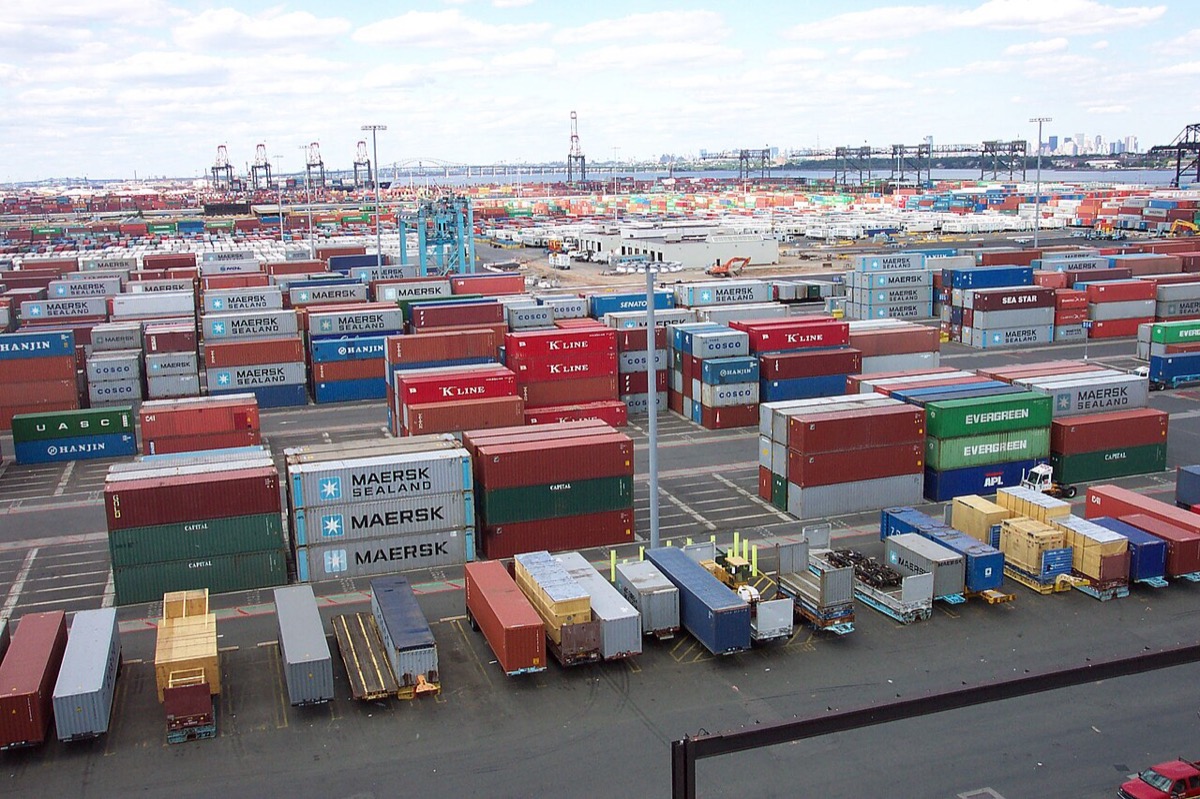
If you’re moving chemicals into the US west coast via any COSCO, OOCL or CMA CGM service, your per-TEU cost base just shifted up by 7 to 12 percent before carrier rate movements are even considered. More strategically, the port fee regime is accelerating the fleet reshuffle: non-Chinese tonnage is being prioritised for Asia-US rotations and Chinese-built capacity is being redeployed to Asia-Oceania, Asia-Europe and Asia-Middle East trades. For Australian importers, that means a short-term capacity glut on Asia-Oceania is possible through early Q1 2026, with rates potentially softening by 5 to 8 percent, before normalising by mid-2026.
USTR port fee pass-through by carrier (October 2025)
| Carrier | Vessel nationality exposure | Port fee pass-through per TEU | Alternative deployment |
|---|---|---|---|
| COSCO | Chinese-operated and built | $140 | Asia-Oceania redeployment |
| OOCL (COSCO group) | Chinese-operated | $135 | Asia-Europe redeployment |
| CMA CGM | Partial Chinese-built | $90 to $110 | Mixed |
| Hapag-Lloyd | Limited Chinese-built | $30 to $60 | Maintained Asia-US focus |
| Maersk | Very limited exposure | $20 to $40 | Maintained |
| MSC | Limited Chinese-built | $25 to $50 | Maintained |
| ONE | Moderate Chinese-built | $60 to $85 | Mixed |
| Hyundai Merchant Marine | Very limited | $15 to $30 | Asia-US premium position |
The arithmetic matters because carrier selection is now a compliance and a cost question, not just a service preference. If you’re running a predominantly COSCO programme to the US market, you’re carrying the largest exposure. If you’re running Hyundai Merchant Marine, Maersk or Hapag-Lloyd non-Chinese built tonnage, your exposure is minimal. Many Australian importers we speak with run mixed programmes and have never audited their vessel provenance. That audit is now a Q4 must-do.
The October 27 Phase One investigation: what USTR is actually asking
On 27 October, USTR formally initiated a Section 301 investigation into China’s compliance with the Phase One trade agreement signed in January 2020. The investigation’s scope is broad: manufactured goods, agriculture, energy, services, and intellectual property commitments. The critical question for chemical importers is whether USTR uses the investigation to justify an additional Section 301 tariff tranche on Chinese-origin chemical HS codes that were not originally captured, or to raise existing List 3 and List 4A rates.
Phase One committed China to $200 billion in incremental US goods and services purchases over 2020 and 2021. Actual performance was roughly 58 percent of the target. USTR has grounds to find non-compliance. The next steps on the statutory timeline: public comment window opens mid-November, hearings in January or February 2026, preliminary determination by Q2 2026, remedies (if any) effective Q3 2026. Chemical importers serving the US market should be modelling a scenario in which List 3 rates move from 25 percent to 30 percent on chemical HS codes 28xx, 29xx, 38xx and 39xx, with an effective date around 1 July 2026. That’s not a prediction, it’s a planning band.
Phase One investigation: chemical HS codes at exposure
| HS code chapter | Description | Current Section 301 | Scenario uplift | Affected Australian re-export volumes |
|---|---|---|---|---|
| 28 | Inorganic chemicals | 25% (List 3) | +5% scenario | Medium |
| 29 | Organic chemicals | 25% (List 3) | +5% scenario | High (solvents, intermediates) |
| 38 | Miscellaneous chemical products | 25% (List 3) | +5% scenario | High (catalysts, additives) |
| 39 | Plastics and articles | 25% (List 3) | +5% scenario | Very high (resins, compounds) |
Landed cost walkthrough: 40 ft container of catalyst intermediate, Qingdao to Melbourne re-exported to LA
Let’s run the maths on a compounding scenario. Base case: one forty-foot container, 18 MT net, of a zeolite-based catalyst intermediate (HS 3815.19), ex-Qingdao, inbound to Port of Melbourne for Melbourne reformulation, then re-exported to the Port of Los Angeles for end-use in a US refining customer. This is a representative specialty trade flow for a mid-tier Australian importer.
Landed cost per MT: pre-October 9 vs post-October 27
| Cost component | Pre-9 Oct 2025 | Post-27 Oct 2025 | Delta |
|---|---|---|---|
| FOB catalyst intermediate | $4,200 / MT | $4,290 / MT | +$90 |
| Ocean freight Qingdao-Melbourne | $95 / MT | $98 / MT | +$3 |
| DG surcharge | $13 / MT | $13 / MT | $0 |
| Port of Melbourne THC, wharfage | $48 / MT | $48 / MT | $0 |
| Australian brokerage + GST | $430 / MT | $439 / MT | +$9 |
| Melbourne reformulation cost | $320 / MT | $320 / MT | $0 |
| Onward freight Melbourne-LA | $135 / MT | $158 / MT | +$23 |
| USTR port fee (COSCO rotation) | $0 | $7.80 / MT | +$7.80 |
| US customs brokerage | $22 / MT | $22 / MT | $0 |
| US Section 301 duty at 25% | $1,072 / MT | $1,095 / MT | +$23 |
| MPF, HMF | $8 / MT | $8 / MT | $0 |
| Total landed cost per MT (LA delivered) | $6,343 | $6,499 | +$156 |
A $156 per MT uplift on 18 MT equals $2,808 per container. On a programme of 120 containers a year re-exported into the US market, that’s $336,960 of additional cost base you need to either absorb, re-price, or rework your sourcing around. The Phase One investigation remedy, if it lands at a 5 percent additional Section 301 tariff tranche, would add another $214 per MT to the same shipment, taking the annualised uplift toward $800,000 on the same 120 container programme.
What to do before 15 November
Before 15 November you need to have completed four workstreams. Audit your top twenty SKUs against the twelve-element rare earth list for any embedded controlled inputs, even at trace concentrations. Require your Chinese suppliers to state in writing whether any of your Q1 2026 bookings involve controlled inputs and if so confirm they hold valid MOFCOM export licences. Conduct a vessel provenance audit across all your active bookings, flagging any COSCO or OOCL movements into the US market for rate renegotiation or carrier substitution. Model your FY26 landed cost with three scenarios: Phase One status quo, 5 percent Section 301 uplift on chapters 28 to 39, and a Phase One settlement that rolls back port fees in exchange for chemical purchase commitments.
None of this is theoretical. Importers who ran this drill before the 9 October announcement already have a six-week head start. Those who start now are on time. Those who wait until Q4 earnings close have three weeks of margin pressure ahead of them and will be negotiating Q1 contracts without the data they need.
Your next action this week
Brief your three largest ex-China suppliers in writing this week that your Q1 2026 order confirmation is contingent on an audited certificate of non-involvement with the twelve controlled rare earth elements, or in the alternative a copy of the MOFCOM export licence for any controlled inputs. Second, get your freight forwarder to produce a vessel provenance report for every booking through February 2026 and flag every COSCO and OOCL leg for repricing. Third, have your Australian customs broker and your US customs broker on a joint call before end of October to agree a coordinated entry strategy that anticipates the Phase One remedies timeline.
Sourzi monitors MOFCOM, USTR and GACC announcements in real time and runs scenario-based landed cost modelling for Australian chemical importers across the top forty HS codes. If you want a vessel provenance audit, a rare earth exposure check on your BOM, or a Phase One scenario model for your FY26 plan, contact us and we’ll deliver inside ten business days.