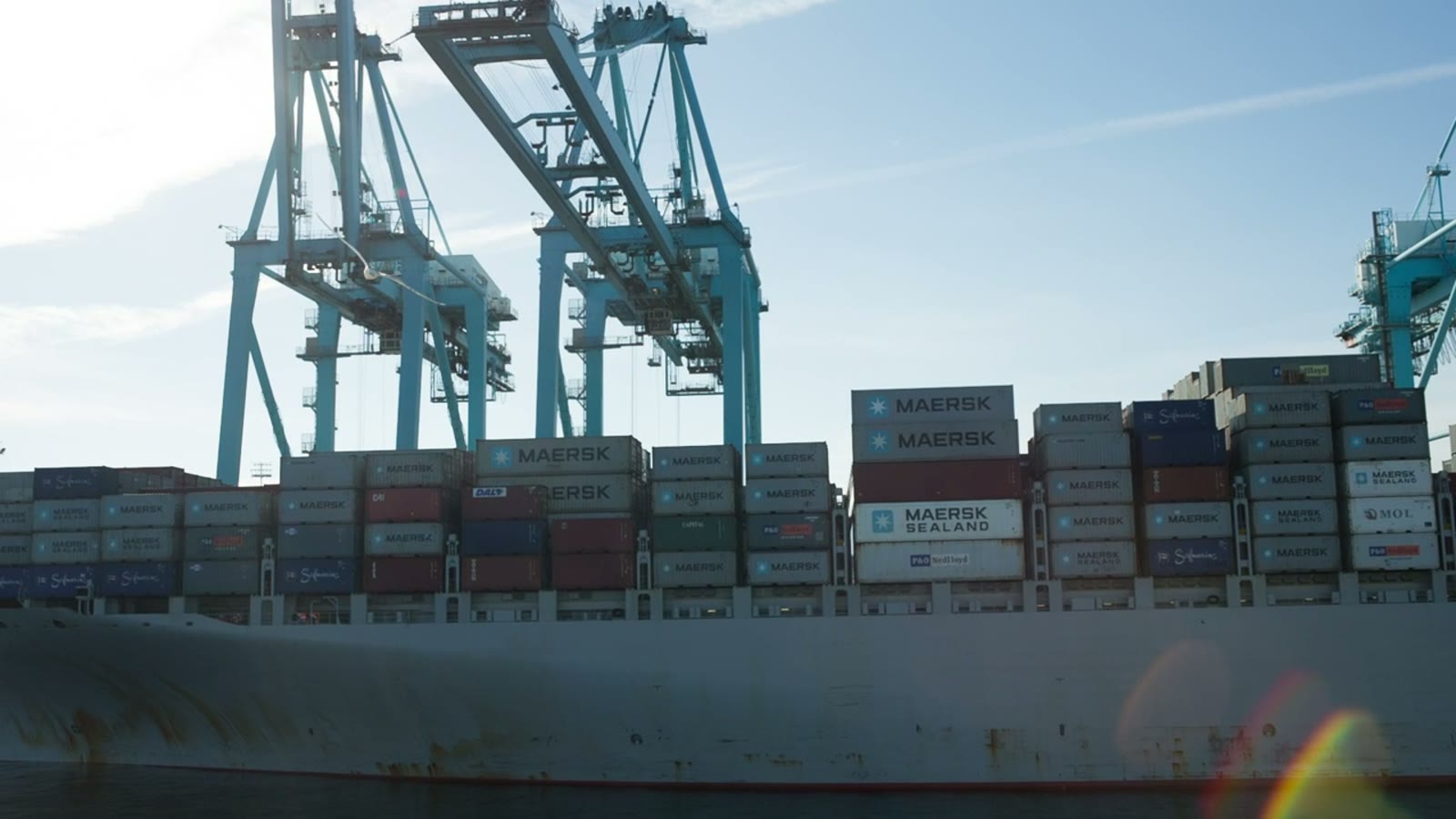
Historical correction, 10 October 2026: The fee developments below occurred after the preserved 15 October 2021 archive date. This correction fixes the programme timeline, thresholds and dependent example arithmetic; the vessel discussion now attributes a 14 October quotation preserved in a 19 October government presentation, which also postdates that archive date. The direct Marine Exchange record, other queue estimates, market quotes and original publication/photo provenance remain unverified.
An FDOT presentation dated 19 October 2021, on PDF page 47, preserves a Marine Exchange quotation dated 14 October: 91 container ships in port at Los Angeles and Long Beach, including 64 at anchor or in holding areas and 27 berthed. This is a government-preserved quotation, not an independently retrieved Marine Exchange report. It does not support the earlier claim of 108 waiting container ships or a new all-time record. The Biden administration announced a White House port envoy and committed the Port of Los Angeles to 24/7 gate hours. Later that month, the ports announced a proposed Container Dwell Fee, initially covering containers at nine days or more for truck moves and six days or more for rail moves. Walmart, Target, Home Depot, Costco, and Samsung all confirmed they were chartering their own vessels to bypass the main trans-Pacific liner services.
If you are a chemical importer with a container waiting for a berth, or with a PO that’s supposed to sail out of Ningbo in the next two weeks, you are out of time to hope this clears up. Your cargo is sitting on the water or in a Chinese yard, and the decisions you make between now and month-end determine whether you keep your US customers supplied through Q1 2022 or start losing accounts.
This is the practical playbook: what to do right now, this week, and this month. Divert, reroute, pull forward, renegotiate, and cap your exposure. Specific moves with specific numbers.
What the Dated Vessel Record Says About the Queue
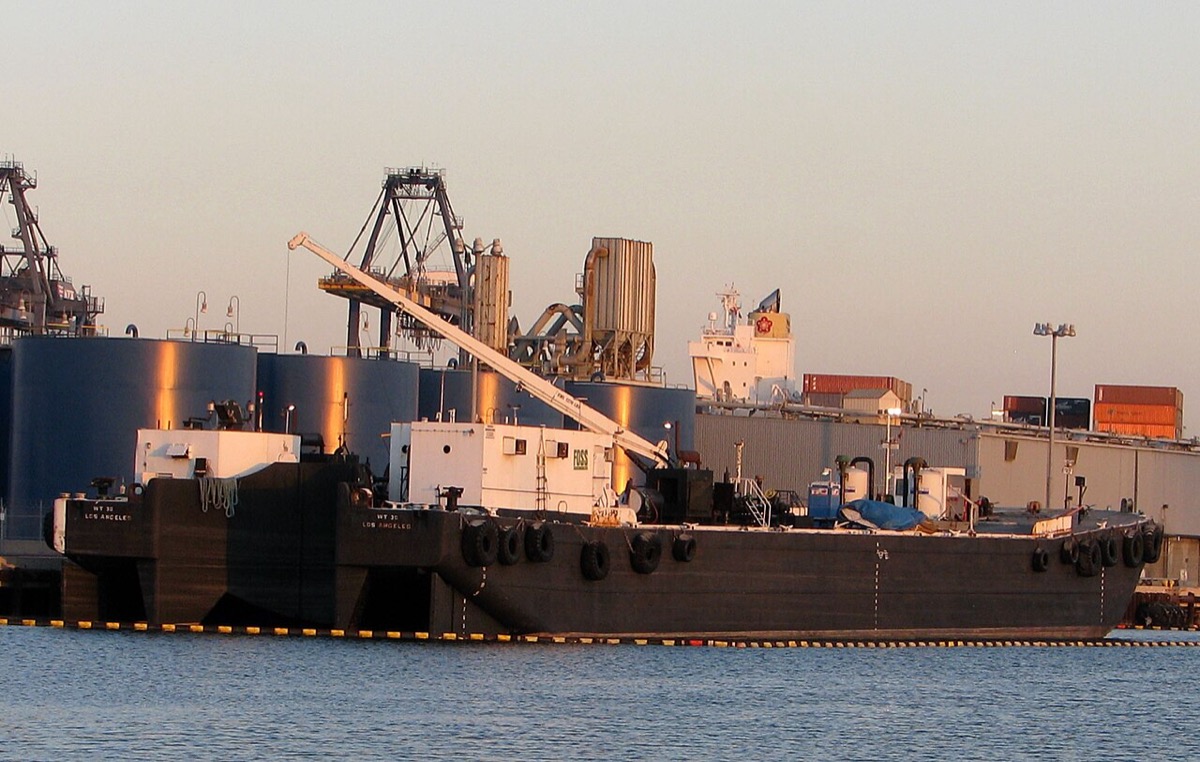
The earlier attribution of 108 vessels waiting on 13 October, split into 60 anchored and 48 drifting, remains unverified and is withdrawn. The different 14 October quotation distinguishes 139 ships of all types, with 83 at anchor or in holding areas and 56 berthed, from its 91 container ships. The 28 container ships in holding areas are a subset of the 64 waiting container ships, not an additional count. It does not substantiate the article’s earlier June, August or record-setting comparisons.
Wait times before berthing have extended to 13 to 18 days depending on terminal. Some vessels have sat at anchor for over three weeks waiting for a berth at APM Terminals Pier 400 or TraPac. Once berthed, discharge rates have also slowed because yard density at LA/LB is running at 95%+ utilisation. Terminals are literally running out of physical space to put boxes.
The White House 24/7 announcement on October 13 sounds like it should move the needle. In practice, it won’t, at least not quickly. The bottleneck isn’t gate hours. It’s chassis availability, warehouse space, and drayage capacity. Extending gate hours when chassis are already parked under loaded boxes in customer yards doesn’t create new chassis. It creates the theoretical option to move more containers that nobody has chassis to move.
The Container Dwell Fee and Why It’s Aimed at You
The ports announced the proposal on October 25, 2021. Los Angeles approved it on October 29, with the programme starting November 1 and fee assessment no earlier than November 15. Its initial thresholds were nine days for truck containers and six for rail. The proposed charge started at $100 per container and increased by $100 on each subsequent chargeable day.
The proposal targeted ocean carriers, but the ports never activated or collected this fee. The collection option ended on January 24, 2023. Ordinary contractual demurrage and detention are separate charges; check your actual bill of lading and tariff rather than assuming this proposed port fee was passed through.
The practical response is two-fold. First, you need a chassis on the ground the day your container discharges, and you need your drayage carrier to pick it up and move it. Second, if your warehouse or consignee can’t receive the box within the free time, you need a drop yard. Compare the quoted drop yard cost with the actual contractual demurrage and handling charges; the proposed port fee was not collected.
Port Diversion: Oakland, Tacoma, Prince Rupert, Houston
This is the single most impactful move most chemical importers can make right now, and too few are making it. LA/LB isn’t the only deepwater gateway for Asia-Pacific cargo. It’s just the most congested.
Oakland has been running an anchor queue of 0 to 6 vessels through most of Q3 and early Q4. Ocean freight rates to Oakland are essentially identical to LA/LB on major trade lanes, roughly $16,000 to $18,000 per 40-foot container from Shanghai or Ningbo as of mid-October 2021. Terminal handling and drayage costs in the Bay Area are higher than LA basin, but they’re real and available. If your consignee is in Northern California, Nevada, Oregon, or anywhere west of the Rockies other than LA basin, Oakland is faster and cheaper door-to-door right now.
Seattle and Tacoma (the Northwest Seaport Alliance) have congestion of their own, running around 10 to 18 vessels at anchor, but that’s a fraction of SoCal. Transit times via Seattle to Midwest rail ramps are 1 to 2 days longer than LA, but with current LA dwell times, you’re often still faster. BNSF and UP rail service out of the Northwest has been less congested than out of LA.
Prince Rupert, Canada, is the sleeper option. The port of Prince Rupert runs fast, has a direct CN rail service into Chicago and the US Midwest, and has maintained relatively low congestion through 2021. Ocean transit from Shanghai to Prince Rupert is actually shorter than Shanghai to LA by approximately 2 days because it’s a more northerly great-circle route. For Midwest or East Coast chemical consignees, Prince Rupert plus CN rail is a genuine alternative. Customs clearance into the US is handled via in-bond transit from Prince Rupert to the US rail ramp.
The Gulf Coast, specifically Houston, is a longer ocean transit, 30 to 35 days from China via Panama, but Houston hasn’t been meaningfully congested and for chemical importers with Gulf Coast customers or storage, it can be the most operationally sensible route. The Panama Canal has handled the New Panamax-sized vessels well since the 2016 expansion.
| Discharge Port | Dated Queue Reference | Ocean Transit from Shanghai | Typical FAK 40ft Spot Rate | Inland to Chicago | Best Fit |
|---|---|---|---|---|---|
| Los Angeles / Long Beach | 64 waiting container ships in the quoted 14 Oct report | 16 to 22 days | $16,000 to $18,000 | 4 to 7 days rail | If cargo must land SoCal |
| Oakland | 0 to 6 vessels | 16 to 20 days | $16,500 to $18,000 | 4 to 6 days rail | NorCal, PNW, Nevada |
| Seattle / Tacoma | 10 to 18 vessels | 13 to 17 days | $17,500 to $19,500 | 3 to 5 days rail | Midwest, rail-heavy |
| Prince Rupert, BC | 0 to 4 vessels | 12 to 15 days | $15,500 to $17,500 | 3 to 4 days CN rail | Midwest, East Coast |
| Houston | 4 to 9 vessels | 30 to 35 days | $14,500 to $16,500 | 2 to 4 days truck/rail | Gulf, SE, Texas |
The LA/LB queue cell refers only to the dated quotation above. The other port queue counts, transit estimates and market rates in this table remain unverified; they are not comparable observations from that report.
Run the maths on your specific lane. For many chemical importers, the all-in landed cost via Oakland or Prince Rupert is actually lower than LA/LB once you bake in realistic demurrage, detention, and chassis costs.
Pulling Forward: Moving October Inventory Into September Sailings You Can’t Do Anymore, So What Next
You can’t pull forward October orders into September at this point because September sailings are full and already sailed. What you can do is pull forward December and January orders into November and early December, and lock in the booking window now. Peak season runs through early November on the trans-Pacific, then tapers. December sailings will have more space than October sailings, but you need to book now, not in three weeks.
This has financing implications. Pulling forward inventory means tying up working capital 30 to 45 days earlier than planned. For a chemical importer with a $3 to $5 million quarterly buy, that’s $200,000 to $400,000 of incremental working capital. Work with your bank or finance team on a temporary line adjustment.
It also has warehouse implications. US warehouse vacancy rates in major logistics markets are running below 4%, the lowest in decades. If you’re planning to land an extra month of inventory, you need the storage locked in before the cargo arrives. Third-party logistics providers in the Inland Empire, Phoenix, Dallas, and Atlanta are all running tight.
Renegotiating Incoterms: The Move From FOB to DDP That Actually Makes Sense Right Now
A lot of US chemical importers buy on FOB China terms. You own the cargo from the moment it passes the ship’s rail, you book your own freight, you pay the freight, you pay the duties, and you pay the destination charges. In a normal freight market, FOB gives you control and typically the best total cost.
In October 2021, that logic has partially inverted. Large Chinese chemical traders with FAK contracts to COSCO, OOCL, CMA CGM, and Evergreen have freight allocation you can’t replicate on spot. They can get your container loaded in week 43 while your NVOCC on spot can’t get space until week 48. For certain products and suppliers, moving from FOB to CIF or even DDP, where the Chinese seller handles logistics all the way to your door, is worth a 5 to 10% premium on the landed price because it actually gets the cargo delivered.
The caveat is you need to verify the Chinese supplier’s freight arrangements are legitimate. Ask for the carrier’s booking confirmation, the vessel name and voyage, and the bill of lading when it’s issued. Some less scrupulous traders will quote DDP and then sit on the cargo hoping the freight market eases.
For ISO tank shipments of liquid chemicals, the logic is different. Chemical tank operators like Stolt, Odfjell, and Den Hartogh run their own tank networks with dedicated allocations that don’t go through the container spot market. Your freight forwarder or direct contract with the tank operator matters more than the Incoterm.
A Worked Landed Cost: LA vs Oakland vs Prince Rupert for a Chemical Container
This is an illustrative comparison using the existing, unverified cost inputs, not a historical invoice or verified market quotation. Assume you are importing 20 MT of Chinese calcium hypochlorite (HTS 2828.10, Section 301 List 3 at 25%) in a 20-foot dry container, ex-works Jiangsu, destined for a water-treatment distributor in Denver, Colorado. Product cost is $1,450/MT ex-works.
| Cost Component | LA/LB Route | Oakland Route | Prince Rupert Route |
|---|---|---|---|
| Ex-works product (20 MT at $1,450) | $29,000 | $29,000 | $29,000 |
| China inland + export clearance | $650 | $650 | $650 |
| Ocean freight (20ft dry, FAK) | $9,800 | $10,100 | $9,400 |
| Peak season and congestion surcharges | $1,400 | $900 | $500 |
| US customs clearance and MPF (or in-bond to PR) | $360 | $360 | $420 |
| HMF (harbour maintenance fee) | $45 | $45 | $0 (Canadian port) |
| Section 301 duty (25%) on $29,650 customs value | $7,413 | $7,413 | $7,413 |
| Terminal handling | $380 | $420 | $310 |
| Demurrage allowance (LA assumes 5 chargeable days) | $1,150 | $180 | $90 |
| Chassis and drayage premium | $780 | $520 | $280 |
| Inland transit to Denver | $1,950 (rail from LA) | $2,100 (rail from Oakland) | $1,700 (CN rail via Chicago interchange) |
| Port Container Dwell Fee (never collected) | $0 | $0 | $0 |
| Total landed cost | $52,928 | $51,688 | $49,763 |
| Per MT | $2,646.40 | $2,584.40 | $2,488.15 |
With those illustrative inputs, Prince Rupert is $158.25/MT cheaper than LA, and that’s before you account for the transit-time saving of roughly 14 days door-to-door. Oakland is $62/MT cheaper. For a chemical importer running 50 to 100 containers a year through LA/LB, the diversion maths is worth six figures.
Demurrage and Detention Discipline: The Operational Tightening
Congestion amplifies demurrage and detention exposure. Terminals charge demurrage for containers sitting at the port past the free time, typically four to five days for dry containers and three days for ISO tanks. Ocean carriers charge detention for their containers sitting outside the port past the return window, typically seven to ten days.
In a normal freight environment, you can manage this with basic planning. In October 2021, with chassis scarcity and terminal dwell running long, you can accumulate thousands of dollars of charges without anyone on your team doing anything wrong. The container is on the ground at the terminal, there’s no chassis available to pull it, and the meter is running.
Operational moves that work. Negotiate free-time extensions with your carrier up front, before the cargo ships. Many carriers will extend to seven days for truck and eleven days for rail on request if you commit volume. Build a direct relationship with at least two drayage carriers in your destination market, not just one. Carriers get throttled. Your second carrier bails you out. Use a drop yard with a long-term storage rate if your warehouse is bottlenecked. Drop yards in the LA basin charge $25 to $45 per day. Compare that with your actual terminal demurrage terms and handling costs; the port programme did not add a collected dwell fee.
And on the contracts side, write detention and demurrage caps into your NVOCC or forwarder agreements. Not every provider will agree, but some will accept a $2,000 per container cap on destination dwell charges if you commit meaningful volume.
What to Watch Through Year-End and Into 2022
The SoCal anchor queue is not going to drop below 50 vessels before January. Peak season imports run through early November, Lunar New Year blanking on trans-Pacific sailings kicks in February, and ILWU contract negotiations for the West Coast port labour agreement begin in earnest early in 2022. Any labour uncertainty at LA/LB in May through July 2022 will push more cargo to alternative ports.
The October 25 announcement was a proposal, not the start of fee collection. It remained uncollected; ordinary carrier and terminal charges require a separate contractual check. Watch whether Oakland and Prince Rupert congestion increases as diverted cargo arrives. Watch the November and December FAK spot rate out of Shanghai, which will tell you whether the worst of the peak-season freight market is behind you.
For any chemical importer with material China exposure, October 2021 is the moment to finish the contingency planning you probably started but didn’t complete in April. Divert a portion of your volume now. Pull forward what you can. Cap your demurrage exposure. Get your Incoterms right. The US ports are going to be messy through at least the first half of 2022, and the importers who come out of this with customer relationships intact are the ones who diversified their routing this month, not next quarter.