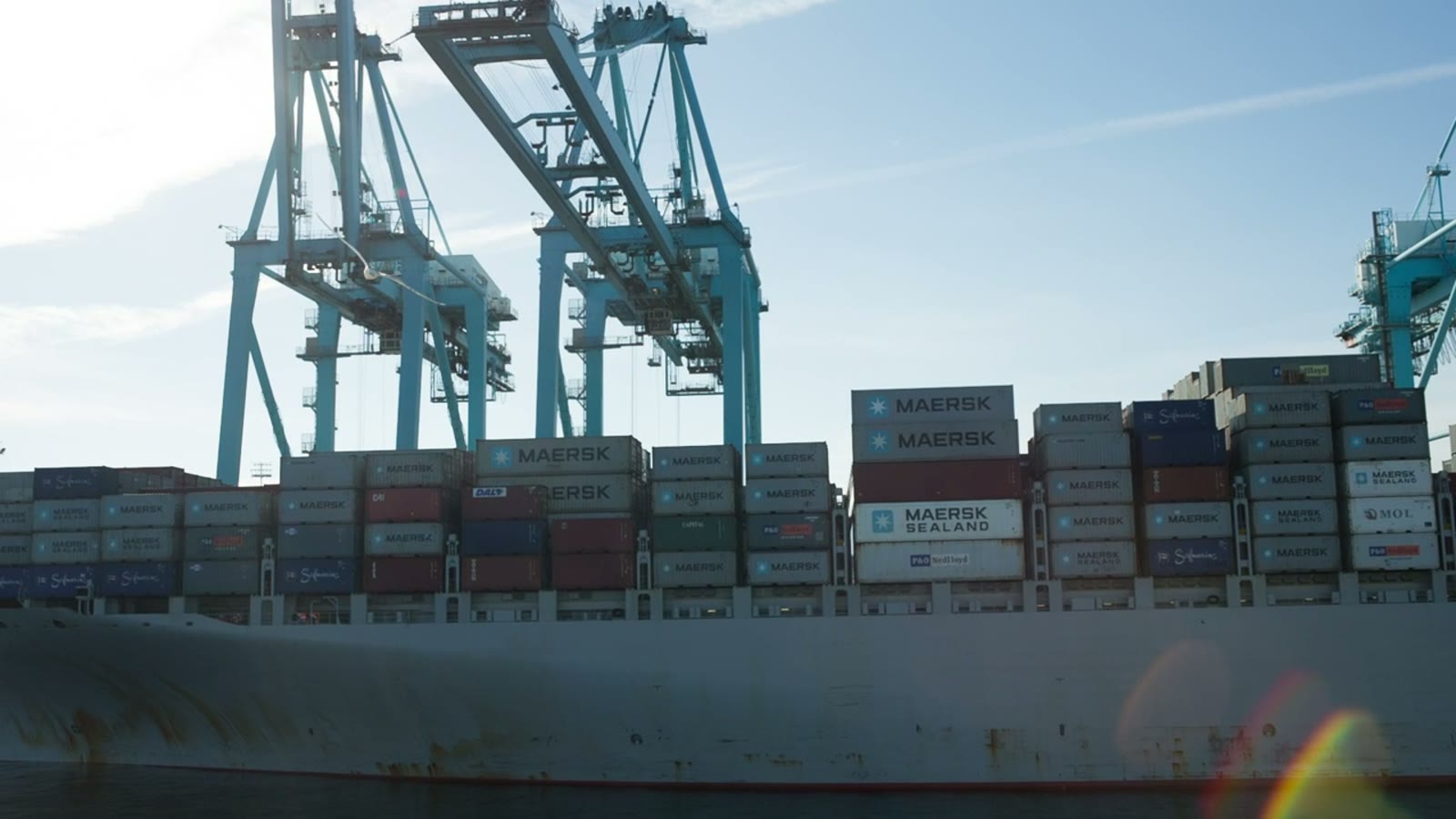
If you have a container of Chinese chemical cargo scheduled to hit Los Angeles this month, you need to assume it will sit on the water for 10 to 14 days before it berths, another 7 to 10 days in the yard before it is picked up, and then you will fight for a chassis and a drayage slot to move it inland. What used to be a 32 to 35 day door-to-door run from Shanghai or Ningbo to a warehouse in Ontario, California has stretched past 12 weeks for some importers, and the Marine Exchange of Southern California is reporting more than 40 vessels at anchor off San Pedro Bay on any given day.
This is not a one-port story. Yangshan and Ningbo-Zhoushan are backed up on the other end. Yantian still has not fully normalised since the late-May COVID shutdown at Meidong Terminal that held roughly 357,000 TEU of export cargo hostage for over a month. You are now stacking congestion on congestion, and it is showing up in your chemical import P&L in four different places: freight, demurrage, detention, and lost customer commitments.
Here is what is actually happening on the ground, what it costs you, and the moves you should be making with your forwarder and your Chinese suppliers right now to stop the bleeding.
Why San Pedro Bay Has Turned Into a Parking Lot for 40+ Vessels
Los Angeles and Long Beach together handle around 40% of all US containerised imports. On a normal day, ships call, berth within hours, discharge, and sail. In August 2021, that choreography has collapsed. The Marine Exchange of Southern California started publishing daily anchor-queue numbers mid-year, and by early August the count was sitting between 35 and 44 vessels, with no meaningful relief in sight.
The root cause isn’t a single bottleneck. It is a chain of them. Import volumes into LA/LB are running roughly 20 to 30% above 2019 levels, driven by US consumer demand rebounding hard on stimulus spending. Terminal yards that were designed for 55 to 65% utilisation are running at 90%+ occupancy. That yard density is the real killer, because you can’t discharge a ship efficiently when every empty slot is already full of containers that nobody has picked up.
Chassis availability has cratered. The Pool of Pools, the shared chassis fleet for the LA/LB basin, has been running with dwell times on chassis sitting under loaded boxes at more than double pre-pandemic norms. When chassis are parked under containers in somebody’s warehouse yard for 14 days instead of 3, the pool shrinks, drayage carriers can’t dispatch trucks, and the yard can’t clear itself out. It feeds back into the anchor queue.
Chemical cargo, particularly ISO tanks and flexibag-loaded dry containers, isn’t treated specially by the terminal. Your 20-foot tank of diethylene glycol or your flexi of plasticiser sits in the same stack as everybody else’s toys and treadmills.
What the Chinese End Looks Like and Why It Makes the US Problem Worse
The assumption a lot of US buyers are making is that the problem is purely American. It isn’t. Yangshan, the deepwater outport of Shanghai, has been running at high utilisation all year, and weather events plus COVID testing protocols have introduced rolling two to four day berthing delays for months. Ningbo-Zhoushan had its own COVID incident at Meishan Terminal on August 11, 2021, when a dockworker tested positive and the terminal closed for two weeks, dumping vessel strings onto other Ningbo terminals and into Shanghai.
Before that, Yantian’s May to June 2021 shutdown of the Meidong and Meisha terminals had already absorbed about three weeks of export capacity from South China. Carriers skipped port calls, rolled cargo, and the backlog pushed into July. Vessels arriving at LA/LB in August are carrying cargo that was originally booked for June sailings out of South China.
The compounding is ugly. A container of Chinese MDI from Yantai that was supposed to sail on July 20 gets rolled to the August 3 vessel. That vessel then sits at anchor off San Pedro Bay for 12 days. Then the container spends 9 days in the stack because your drayage carrier can’t get a chassis. Then the chassis sits under your container at your Ontario warehouse for 4 days because the receiving yard is full. You just turned a 32-day transit into a 68-day transit, and you are paying detention charges on days 8 through 16 at the terminal plus per diem chassis charges somewhere in that window too.
The Real Numbers: Lead Times and Surcharges as of August 2021
Let’s put actual figures on this. The table below is assembled from spot FAK freight quotes, NVOCC indications, and typical chemical-importer dwell times we’ve been tracking through Q3 2021.
| Component | 2019 Baseline | August 2021 Actual | Delta |
|---|---|---|---|
| Shanghai/Ningbo to LA ocean freight (40ft dry, FAK) | $1,800 to $2,200 | $14,000 to $18,000 | 7 to 8x |
| China origin to vessel load (day count) | 7 to 10 days | 14 to 25 days | +14 days |
| Ocean transit Shanghai to LA | 14 days | 16 to 22 days | +6 days |
| Anchor wait off San Pedro Bay | 0 to 1 day | 10 to 14 days | +12 days |
| Terminal dwell after discharge | 3 to 5 days | 7 to 12 days | +6 days |
| Chassis/drayage wait in LA basin | 1 to 2 days | 4 to 9 days | +6 days |
| Inland transit to Ontario, CA | 1 day | 2 to 3 days | +1 day |
| Total door-to-door | 32 to 35 days | 68 to 90 days | +40 days |
On top of the spot freight number, you are also absorbing General Rate Increases, Peak Season Surcharges, and in several trade lanes a Congestion Surcharge of $750 to $1,500 per container layered on top. Some NVOCCs are quoting a Premium Service product that promises loading priority for an additional $3,000 to $5,000 per box. You can pay it and still get rolled.
What a Chemical Container Actually Costs You Right Now: A Worked Example
Let’s run the maths on a realistic August 2021 shipment. You are importing 18 metric tonnes of a Chinese specialty plasticiser, packed in a 20-foot dry container with flexibags, ex-works Jiangsu, destined for a compounder’s plant in Southern California. The ex-works product cost is $1,650/MT.
| Cost Component | Per Shipment | Per MT |
|---|---|---|
| Ex-works product cost (18 MT at $1,650) | $29,700 | $1,650 |
| Inland trucking Jiangsu to Shanghai | $450 | $25 |
| Chinese export clearance and documentation | $180 | $10 |
| Ocean freight Shanghai to LA (20ft dry, FAK) | $9,800 | $544 |
| Peak season and congestion surcharges | $1,200 | $67 |
| US import customs clearance and merchandise processing fee | $320 | $18 |
| HMF, harbour maintenance fee | $45 | $2.50 |
| Section 301 duty (25%, HTS 3812) on $30,150 customs value | $7,538 | $419 |
| Terminal handling and port fees | $420 | $23 |
| Demurrage (assume 4 chargeable days at $150/day rising tier) | $780 | $43 |
| Chassis per diem and drayage premium | $650 | $36 |
| Detention at destination (3 days at $110) | $330 | $18 |
| Inland drayage to Ontario, CA | $720 | $40 |
| Total landed cost | $52,133 | $2,896 |
In Q4 2019, that same shipment lands at around $2,150/MT. You’re paying $746/MT more, or a 35% jump, almost entirely on freight, surcharges, and congestion-driven ancillary charges. If you sell that compound on a fixed-price contract with quarterly resets, you’re eating it.
The Moves to Make This Week: Routing, Booking, and Demurrage Discipline
You don’t fix this at the macro level. You fix it with small, repeatable operational decisions, and you start today.
Lock in booking windows four to six weeks ahead of ex-works readiness with your forwarder, and get the booking confirmed in writing with named vessel and voyage number, not just a general service string. Space on any given trans-Pacific sailing is being allocated days before the ship arrives at the loading port. If your shipper is waiting for you to confirm the PO before they book, you’re already late.
Consider splitting your sourcing between Shanghai and Ningbo, and explore routing some cargo through Xiamen or Qingdao. South China origins to LA/LB aren’t faster right now, but they give you carrier optionality when one load port has a COVID event. A single-origin programme is a fragility.
Push hard on Oakland as an alternative discharge port. Oakland has been running with substantially shorter anchor queues than LA/LB through most of 2021, sometimes zero vessels waiting. For chemical cargo heading to Northern California or the Pacific Northwest, Oakland is not a compromise, it’s often the better move. For cargo destined for LA basin customers, the inland trucking cost from Oakland is higher, but if it saves you 15 days of transit and demurrage, the arithmetic works.
Write detention and demurrage caps into your freight contracts. You won’t eliminate the exposure, but you can cap it. Some NVOCCs will accept a liability cap of $1,500 per container on destination dwell charges if you commit volume.
What to Renegotiate With Your Chinese Suppliers Right Now
Your ex-works or FOB contract with a Chinese supplier was probably written when ocean freight was $2,000 per box and nobody thought about port dwell. It needs a refresh.
Shift from FOB to CIF on any SKU where your supplier has better carrier relationships than you do. Wanhua, Sinopec trading arms, and the major Chinese chemical traders have long-term FAK contracts with COSCO, OOCL, and Evergreen that give them allocation you can’t match on spot. You’ll pay a modest premium in the CIF price, but you’ll move cargo that otherwise sits in a consolidator’s warehouse waiting for space.
Negotiate longer ex-works readiness windows. If your supplier is ready to ship on July 15 but your forwarder can only book August 10 sailing, you want the product staged in a bonded warehouse in Shanghai or Ningbo, not racking up storage charges at the factory and tying up your supplier’s finished goods inventory.
Push for real-time shipment visibility. A good Chinese chemical trader in 2021 has visibility into vessel schedules, rolled bookings, and port calls. If your supplier tells you they’ve handed cargo to the forwarder and they can’t tell you the vessel name, they’re not working for you, they’re working for the invoice.
Where This Goes Next and What to Watch Through Q4 2021
San Pedro Bay isn’t getting fixed in Q4. Peak season imports run through October, ILWU labour negotiations are coming in 2022, and the Christmas retail pull is already in motion. Expect the anchor queue to hit new highs before it gets better.
The specific signals worth watching are the weekly Marine Exchange anchor-count reports, the Port of Los Angeles monthly import TEU figures, and any announcement on 24/7 terminal operations which has been floated but not implemented. On the China side, watch for COVID cases at Yangshan and Ningbo terminals, because a single positive test at a key terminal triggers two-week shutdowns under Chinese port protocols.
If you’re running a US chemical import programme dependent on a single trans-Pacific routing to LA/LB, the August 2021 numbers are your wake-up call. Diversify discharge ports, lock in booking windows, cap your demurrage exposure, and push your suppliers to share the logistics workload. The importers who come out of Q4 with margin intact are the ones making those moves this week, not when the next congestion alert lands.