Historical correction, 9 October 2026: RCEP was signed on 15 November 2020; Commerce added SMIC to the Entity List on 18 December, after the preserved 16 November archive date. RCEP began entering into force on 1 January 2022. These are distinct dates, and signature alone did not activate preferences. Other trade and compliance claims remain unverified.
The US election took place on November 3, fifteen countries signed RCEP on November 15, and Commerce later added SMIC to the Entity List on December 18. Most procurement teams tracked the headlines and moved on. That was a mistake, because if you source chemicals from China for US manufacturing, those three events together draw a clear picture of where this trade relationship is heading over the next two to three years, and the picture has direct implications for your tariff costs, your compliance exposure, and the economics of the ASEAN diversification strategy you have probably been meaning to get started on.
“Strategic Patience” Translated Into Dollars on Your Invoice
“Strategic patience” is the phrase Biden’s transition team used to describe their China trade approach. It is worth unpacking exactly what those two words mean for the number on your customs clearance document.
Strategic patience means the Section 301 tariffs are staying. Not staying temporarily while the new administration conducts a review. Staying as a deliberate policy instrument that Biden’s team views as leverage for future engagement with Beijing, not as a Trump error to be quickly corrected. The transition team said this clearly and repeatedly. Nobody had to read between the lines.
Your List 3 tariffs at 25% are a permanent line item in your landed cost model for 2021 and almost certainly 2022. List 4A at 7.5% likewise. If you have been carrying any assumption that a Biden win would bring tariff relief in the first half of 2021, close that spreadsheet now and build a new one from scratch with the correct baseline.
| Tariff List | Annual Trade Covered | Key Chemical Categories | Rate |
|---|---|---|---|
| List 1 | ~$34 billion | Certain organic chemicals, resins, HTS Chapters 28 to 29 intermediates | 25% |
| List 2 | ~$16 billion | Inorganic chemicals, semiconductor-related compounds | 25% |
| List 3 | ~$200 billion | Specialty chemicals, adhesives, coatings, plasticisers, commodity organics and solvents | 25% |
| List 4A | ~$120 billion | Selected consumer goods and some specialty chemical categories | 7.5% |
Verify your specific HTS codes against the Federal Register annexes for each list. Not the product description, the actual code. A chemical that sounds like it belongs on List 4A can sit on List 3 based on its HS chapter classification, and that 17.5-point difference is not a rounding error at any significant volume.
The one genuine opening Biden created is the exclusion process. The Trump administration ran the Section 301 exclusion programme inconsistently and with a significant backlog. A Biden USTR was expected to run a more systematic version. If you have chemical inputs with no viable domestic or non-Chinese source, Q1 2021 is when you start documenting that case. Get your paperwork ready before the formal process opens, not after.
RCEP: 30% of Global GDP Just Rearranged Itself and You Are on the Outside
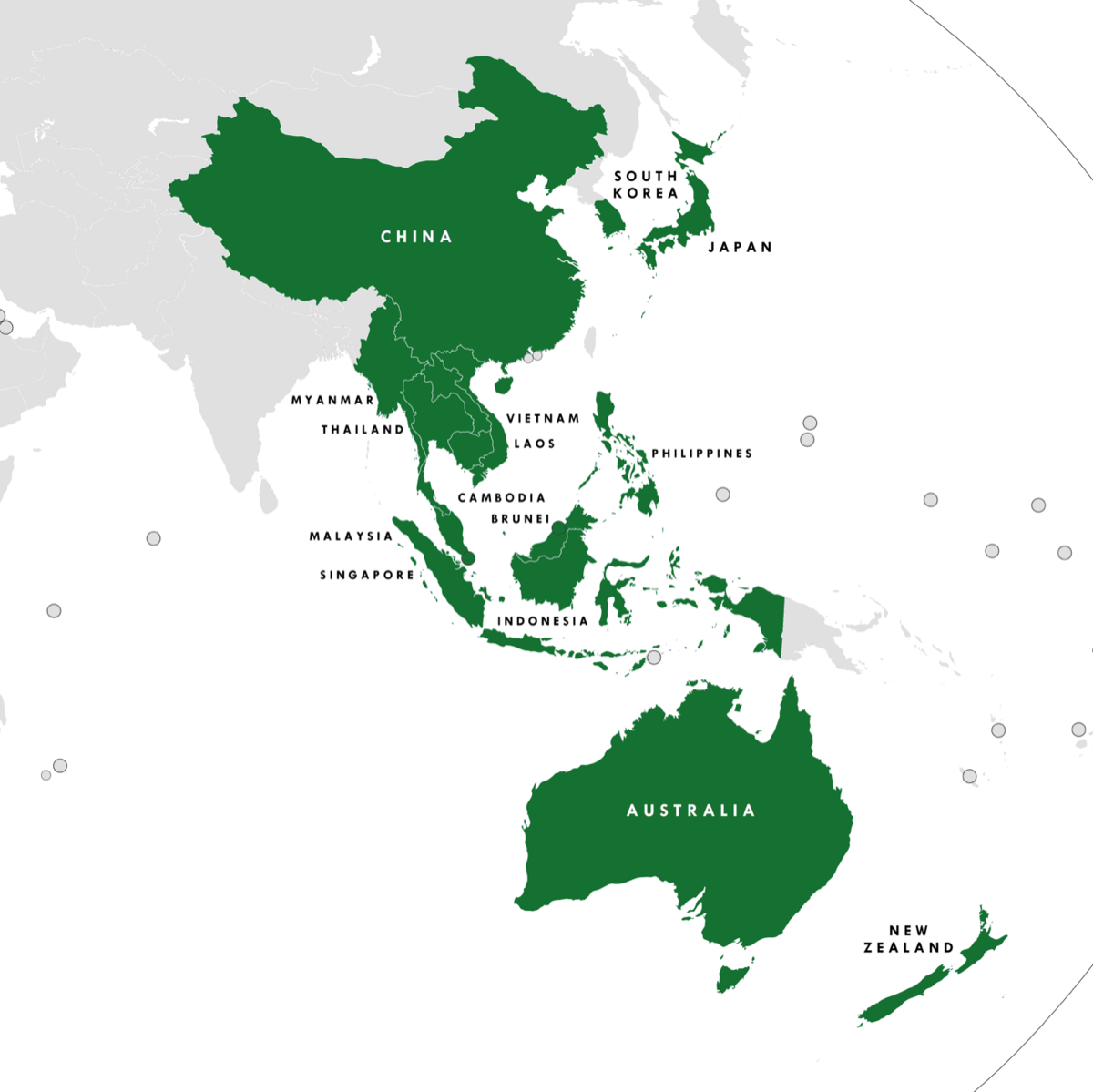
On November 15, 2020, China, Japan, South Korea, Australia, New Zealand, and all ten ASEAN member nations signed the Regional Comprehensive Economic Partnership. It began entering into force on 1 January 2022, rather than on signing. That is 15 countries, roughly 30% of global GDP and 30% of global population inside a single preferential trade framework. The United States is not in it.
That single fact is the most important thing for US chemical buyers to sit with. RCEP is not an immediate threat to your existing supplier contracts. But it is reshaping the economics of the ASEAN diversification strategy you have probably been putting off.
Here is the mechanism that most commentary on RCEP got wrong. Under RCEP, a Chinese chemical producer can increasingly export to Vietnam, Thailand, Indonesia, or South Korea under progressively lower tariff barriers. Simultaneously, a Vietnamese or Thai processor can import Chinese-sourced chemical precursors at RCEP-preferential rates, run those materials through a legitimate processing step domestically, and export the finished product to the US under a separate trade framework. That supply chain structure is real and it is viable for a meaningful range of product categories.
The rules of origin matter here. RCEP Chapter 3 provides wholly obtained, originating-material and applicable product-specific pathways, with cumulation for qualifying materials from other parties. It does not impose a universal requirement for 40% local processing value in Vietnam. RCEP eligibility does not itself establish US origin or exemption from Section 301; assess the destination’s rules separately.
RCEP does not mean you pivot your China volumes to Vietnam in Q1 2021. The capacity constraints are real and Vietnamese chemical manufacturing does not yet have the scale for every category US importers buy from China at volume. But the buyers who start building pilot supplier relationships in ASEAN now will have genuine options in 2023 and 2024 that those who waited will not have.
SMIC on the Entity List: The Compliance Check You Cannot Skip
Commerce added Semiconductor Manufacturing International Corporation to the Entity List on December 18, 2020. SMIC is China’s largest domestic chipmaker. If you are not in the semiconductor business, you might assume this has nothing to do with you. Check that assumption before you rely on it.
Semiconductor manufacturing consumes significant volumes of specialty chemicals, and several of those chemicals are also common industrial imports that US buyers source from China routinely. Ultra-high purity hydrogen peroxide. Concentrated sulphuric acid. Hydrofluoric acid used in silicon etching. Phosphoric acid. Industrial acetone. The SMIC listing does not restrict the import of these chemicals from China to the US. The December 2020 Commerce statement addresses exporters, reexporters and in-country transferors of covered technology, not only US companies. Its stated presumption of denial concerns items uniquely required for semiconductor production at technology nodes of 10 nanometres or below, rather than a general military-application test.
The real concern is not what the listing does today. It is the direction it signals. SMIC was added because Commerce determined there was an unacceptable risk of diversion to Chinese military end-uses. That determination reflects an escalating US posture on technology controls that will likely extend to chemical precursors used in semiconductor manufacturing as Chinese domestic production of those precursors scales up under domestic substitution policy.
If you import hydrogen peroxide above industrial purity grades, hydrofluoric acid, or phosphoric acid for industrial use, the SMIC listing is a prompt to do a compliance check right now. Distinguish US import requirements from EAR controls on covered exports, reexports and transfers within a country. Review the actual item, transaction and end user with qualified advisers; the SMIC listing is not itself a blanket US import ban. Verify that your Chinese suppliers are not named on or affiliated with Entity Listed companies. This should already be part of your routine due diligence. The December listing reinforced the need for a current compliance review.
What the Three Events Say Together
Step back and look at all three in sequence. Biden signals tariff continuity with a more systematic process, not relief. The Section 301 framework stays intact and the only near-term relief valve is the exclusion process, which requires substantial preparation work. RCEP accelerates the economic viability of Southeast Asia as a complementary sourcing base. And the SMIC listing is the clearest signal yet that US export controls on China will expand under the incoming administration, not contract. Biden’s multilateral approach to technology controls was expected to prove more durable than Trump’s unilateral one, which is actually a bigger long-term constraint on Chinese supplier options.
For chemical importers, the practical translation is this: China sourcing is essential in the near term and will not be replaced by anything overnight. But the compliance requirements around that relationship are growing more complex every quarter, and the economic case for building ASEAN alternatives is strengthening. Both of those things should be shaping your planning horizon right now.
Vietnam and Thailand as Supply Chain Hedges: What Actually Changes
Vietnam and Thailand are the RCEP members most immediately relevant to US chemical importers thinking about supplier diversification. Both have existing chemical manufacturing capacity in certain categories, established export logistics to the US, and labour cost structures below China’s current levels.
RCEP improves the economics of diversification in a specific and practical way. After entry into force for the relevant parties, Vietnamese and Thai producers may qualify for preferential treatment on covered Chinese chemical inputs, subject to the applicable schedules and origin rules, process or formulate them domestically, and export the finished product to the US. For product categories that involve multi-step processing where intermediate purity grades are sourced from one country and further refined in another, this supply chain structure works.
The current limitation is capacity. Vietnam’s chemical sector is growing but does not yet have the scale for every category US importers buy from China at volume. That’s a 2023 and 2024 story. But the buyers who start building pilot supplier relationships in ASEAN now, even at a slight cost premium, will have options in three years that those who waited will not. A pilot order in H1 2021 builds the relationship, generates real cost and quality data, and creates genuine optionality for 2022 and beyond before you need it in a crisis.
What These Three Events Mean for Your Planning Horizon
Categorise your full chemical import spend by HTS code. Identify which products sit on List 3 at 25%, which are on List 4A at 7.5%, and which carry any potential Export Administration Regulations compliance obligations. This categorisation is the foundation for every other decision. You cannot improve what you have not mapped.
For each high-spend category where you have no non-China source, document the domestic US supply situation and begin preparing a Section 301 exclusion petition for Q1 2021. The process may not be formally open for new submissions immediately, but having a well-documented case ready when it does open is the difference between getting relief and missing the window.
For lower-spend categories where ASEAN alternatives are feasible, identify two or three candidate suppliers in Vietnam or Thailand and initiate a qualification conversation. A pilot order in H1 2021 builds the relationship, generates real cost and quality data, and creates genuine optionality for 2022 and beyond.
These late-2020 developments did not individually change your sourcing tomorrow. Together they mark a clear inflection point in the direction of travel. The tariff environment is not easing. The compliance requirements are growing. And the geographic alternatives are becoming more economically viable with every passing quarter. Start building for that reality now, while you still have time to be deliberate about it rather than reactive.